MANGBETU
(Democratic Republic of Congo)
Presentation of the Mangbetu People
The Mangbetu occupy the northeastern region of the Democratic Republic of Congo, mainly in the province of Ituri. They are known for their art, music and dance, as well as for their unique traditions. They are recognized for their refined culture, strong aesthetic sense, and the exceptional quality of their artistic production. Their reputation became established at the end of the 19th century with the emergence of the Mangbetu style, which has since become iconic in classical African art.
History and Social Organization
The Mangbetu developed structured kingdoms, often ruled by powerful chiefs surrounded by elaborate courts. Their society valued nobility, diplomacy, education and mastery of the arts.
Contact with neighboring kingdoms encouraged rich cultural blending and a wide stylistic diversity.
The Mangbetu were influenced by other peoples of the region, such as the Pygmies, the Zande and the Azande. They also developed their own political system, led by a king (or Mwami), along with village chiefs.
The Mangbetu are famous for their distinctive hairstyle, known as “the Mangbetu coiffure.” Mangbetu women shaved their heads except for a small square at the back, which was shaped into a bun and decorated with beads and shells. Men often wore facial scarifications, along with braided and ornamented hairstyles.
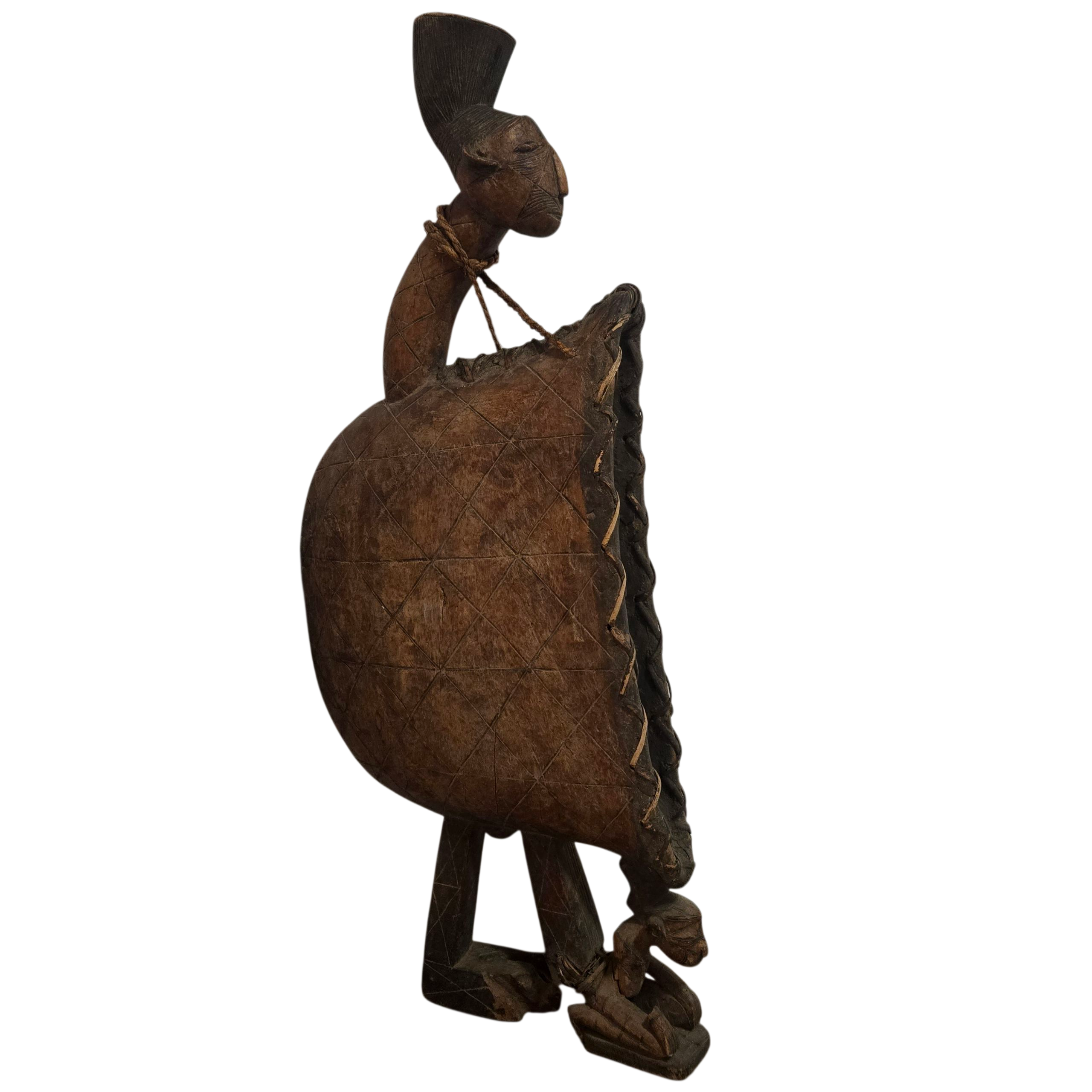
The Mangbetu are also known for their sculptural art, including wooden figures, masks and musical instruments. They also developed a unique style of dance, characterized by rapid movements of the arms and legs.
Lastly, the Mangbetu once practiced headhunting, a tradition that was banned in the early 20th century. This practice involved decapitating enemies during conflicts, shrinking the heads and decorating them as trophies. Today, the Mangbetu no longer engage in this custom and instead focus on preserving their culture and traditions.
Mangbetu Culture and Aesthetics
The Mangbetu style is immediately recognizable:
-
elegance of proportions
-
elongated lines
-
mastered curved forms
-
attention to detail
-
geometric motifs
-
pursuit of visual harmony
This refinement appears in their sculptures, prestige objects, ceremonial knives, musical instruments, and even in their traditional hairstyles.
The Tradition of Cranial Deformation
One of the most famous markers of Mangbetu culture was cranial deformation (called lipombo). Infants’ heads were wrapped from birth in order to elongate the skull.
This elongated form symbolized:
-
nobility
-
beauty
-
intelligence
-
membership in the elite
It shaped the Mangbetu aesthetic and influenced the silhouettes of many sculptures.
Artistic Techniques
Mangbetu artists mastered:
-
woodcarving
-
metal casting
-
sculpted ivory
-
basketry
-
the creation of prestige objects
Their art draws as much from formal elegance as from social symbolism.
Beliefs and Spirituality
Mangbetu spirituality is based on:
-
respect for ancestors
-
protective spirits
-
ritual practices guided by specialists
-
objects invested with power and memory
Each important object served as a link between the human world and the invisible forces.
Importance in African Art
The Mangbetu occupy a major place in the history of Central African art.
Their sophisticated aesthetic influenced Western decorative arts at the beginning of the 20th century and continues to be highly sought after in collections around the world.
Choose by product category
or by ethnies